

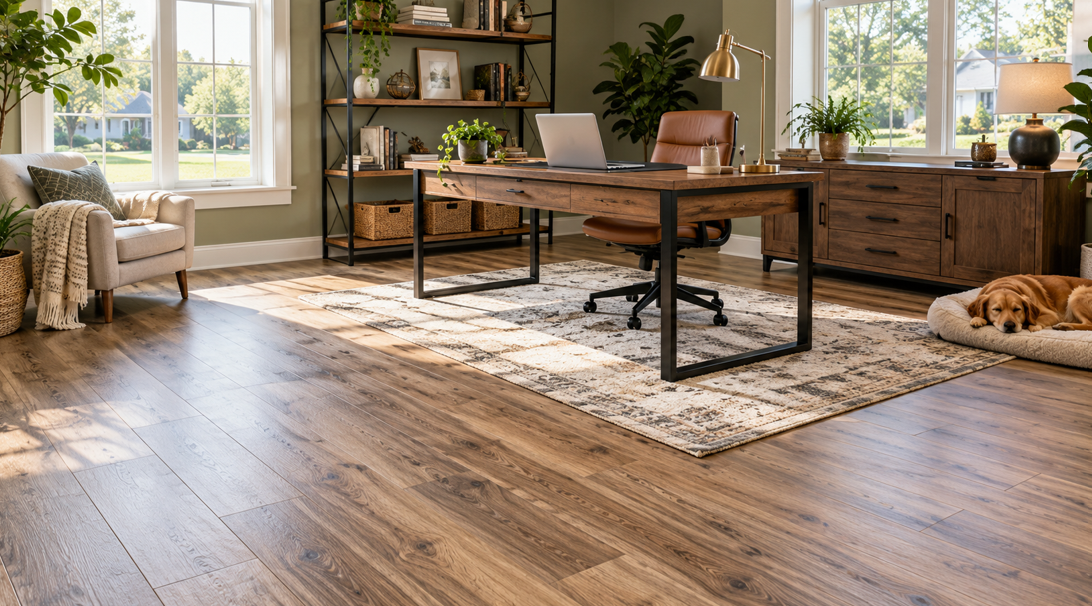
Build a Home Office That Looks Professional and Works Hard
A home office needs to do more than look good on video calls. It has to handle rolling chairs, desks, storage cabinets, daily foot traffic, coffee breaks, charging cables, and long working hours without becoming difficult to maintain.
For homeowners in Beavercreek, Dayton, and Kettering, laminate flooring can be a practical choice for creating a home office that feels polished, comfortable, and easy to live with.
Modern laminate can deliver the warm appearance of wood while offering a durable surface designed for everyday residential use. It works especially well for offices where homeowners want a professional look without choosing a flooring option that feels overly formal.
The right floor can also influence how the entire room feels. A lighter laminate may brighten a compact office, while a warm medium-tone floor can make a larger workspace feel more inviting. Surface texture, plank width, finish, and installation direction all contribute to the final result.
Performance matters just as much as appearance.
A home office often concentrates activity in one small area. You may roll a desk chair over the same section of flooring dozens of times a day. File cabinets place weight in fixed locations. Cords, equipment, and furniture can make cleaning more challenging if the floor is not easy to maintain.
That makes flooring selection an important part of planning the workspace rather than a purely decorative decision.
Homeowners throughout the Dayton area can visit Floorco Flooring to compare laminate options in person and get personalized guidance based on how the office will actually be used.
Why Laminate Works Well in a Home Office
Laminate flooring combines several qualities that suit work-from-home spaces particularly well.
It Creates a Professional Look
A dedicated office feels more complete when the flooring supports the design of the room.
Wood-look laminate can give the space a clean, finished appearance that works with desks, shelving, storage furniture, and different interior styles.
Depending on the design, it can support:
Modern home offices
Traditional studies
Minimalist workspaces
Multipurpose guest-room offices
Creative studios
Small business work areas
The wide variety of available colors and textures makes it easier to coordinate the floor with existing furniture.
It Is Designed for Everyday Use
Home offices can experience more concentrated wear than homeowners expect.
You may walk between the desk, printer, door, and storage area repeatedly throughout the day. Rolling chairs and movable furniture can add even more repeated contact.
A quality laminate product designed for residential traffic can offer a durable surface for this type of routine use.
That durability still works best when combined with simple protection, such as appropriate chair mats or floor protectors where rolling furniture is used.
It Is Straightforward to Clean
A workspace benefits from flooring that does not add unnecessary maintenance.
Dust, crumbs, pet hair, and debris from shoes can collect around desks and office chairs. Routine sweeping or vacuuming with the appropriate setting can help keep the floor looking neat.
For deeper cleaning, homeowners can follow the manufacturer’s care recommendations for the specific laminate product.
It Offers Plenty of Design Flexibility
Laminate can reproduce the look of many wood tones and grain patterns.
That makes it easier to create an office that feels connected to the rest of the home rather than like a completely separate room.
Choose the Right Durability for Your Work Routine
Not every home office experiences the same level of activity.
Someone who works remotely five days a week may place very different demands on the flooring than a homeowner who uses the room occasionally for paperwork.
The right laminate should match how often the office is used and what equipment sits in the space.
Daily Work-From-Home Offices
If the office is used every day, look for laminate intended for active residential areas.
Daily use can involve:
Repeated chair movement
Frequent walking
Visitors or family members entering the room
Equipment being moved
Storage drawers opening and closing
Pets spending time near the desk
A floor designed for regular residential traffic is better suited to this environment than one intended primarily for lightly used areas.
Occasional Home Offices
A room used only a few hours a week may not require the same performance level.
In this situation, appearance, comfort, and coordination with the rest of the home may become bigger priorities.
Small Business or Client-Facing Spaces
Some homeowners use their office for meetings, consultations, tutoring, or other client-facing work.
That may increase foot traffic and make appearance particularly important.
Choose a floor that can handle repeated use while still creating a polished first impression.
Understand Wear Ratings Without Overcomplicating Them
One specification homeowners may notice while comparing laminate is the AC rating, or Abrasion Class rating.
The rating provides information about the level of wear a laminate floor is designed to handle.
You do not need to turn flooring selection into a technical exercise, but the rating can help you understand whether a particular product fits the level of use expected in the office.
A regularly used home office may benefit from laminate designed for heavier residential traffic, especially when rolling furniture or frequent movement is involved.
However, the rating is only one part of the decision.
Also consider:
Product construction
Surface finish
Texture
Warranty
Moisture resistance
Cleaning requirements
Installation method
Compatibility with the room
When comparing laminate flooring, look at how these features work together rather than selecting based on a single specification.
Protect the Floor Under Rolling Office Chairs
Rolling office chairs deserve special attention because they create highly concentrated movement.
The same wheels can pass over a small section of floor hundreds of times during a normal workweek.
Even a durable floor benefits from sensible protection.
Use an Appropriate Chair Mat
A chair mat can create a protective barrier between the chair wheels and the laminate surface.
Look for a product suitable for hard-surface flooring and sized appropriately for your desk setup.
The mat should cover the areas where the chair normally moves rather than only the spot directly underneath the seat.
Check the Wheels
Office chair wheels can collect grit, hair, and debris.
Cleaning them periodically can help reduce the chance of abrasive material being repeatedly rolled across the flooring.
Some homeowners also choose wheels designed for hard flooring, depending on the chair and manufacturer guidance.
Keep the Area Clean
Small particles may seem harmless, but when trapped under rolling furniture they can contribute to surface wear.
Regular cleaning around the desk helps reduce this problem.
Avoid Assuming Scratch-Resistant Means Scratch-Proof
Laminate can be highly durable, but no floor is completely immune to damage.
Chair protection, furniture pads, and routine cleaning can help preserve the surface over time.
Think Carefully About Desk and Furniture Placement
Furniture layout has a major impact on both the appearance and long-term performance of a home office.
Give the Chair Enough Movement Space
Plan enough room behind the desk for the chair to move comfortably.
If the chair repeatedly hits a wall, cabinet, or other furniture, the workspace may feel cramped and movement can become concentrated into an even smaller area.
Use Protective Pads
Furniture pads can be useful under:
Desks
Bookcases
Filing cabinets
Side tables
Storage cabinets
Guest chairs
They can help reduce direct contact between furniture legs and the flooring.
Lift Heavy Furniture When Rearranging
A loaded filing cabinet or desk can place significant pressure on the floor.
When rearranging the office, lifting furniture or using suitable moving protection is safer than dragging it across the laminate.
Plan for Future Changes
Home offices often evolve.
A small desk may eventually be replaced by a larger workstation. A spare bedroom office may later become a full-time workspace.
Choosing a versatile floor allows the room to adapt without needing another design overhaul.
Pick a Color That Supports Focus and Comfort
Floor color can change how a home office feels throughout the day.
Because many people spend hours at a time in the room, creating a comfortable visual environment matters.
Light Wood-Look Laminate
Light flooring can help smaller offices feel brighter and more open.
It works especially well in rooms with:
Limited natural light
Compact layouts
Dark desks
Pale or neutral walls
Light wood tones can create a fresh, modern appearance without making the space feel cold.
Medium Wood Tones
Medium shades are highly versatile.
Warm oak, natural brown, honey, and similar colors can make the office feel comfortable while still looking professional.
They also coordinate easily with many common desk finishes, including black, white, natural wood, and painted furniture.
Dark Laminate
Dark floors can create a sophisticated, dramatic look.
They can work well in offices with good natural light, pale walls, and lighter furniture.
However, darker flooring may make dust, light-colored pet hair, or small surface marks more noticeable depending on the finish.
The choice comes down to how much contrast you want in the room.
Surface Finish Can Make Daily Maintenance Easier
Color is not the only design feature worth considering.
The sheen and texture of the laminate can affect both appearance and practicality.
Matte Finishes
Matte surfaces create a softer, natural look.
They can also make fingerprints, dust, and minor everyday marks less noticeable than highly reflective flooring.
That makes them particularly appealing for busy home offices.
Low-Sheen Finishes
Low-sheen flooring provides a slight polished effect without becoming overly reflective.
It can be a good middle ground for homeowners who want the room to feel finished but still practical.
Textured Wood-Look Surfaces
A textured surface can give laminate a more realistic appearance by recreating wood grain.
The variation may also help minor signs of wear blend into the floor rather than stand out.
For offices where durability and design matter equally, this can be a strong option.
Choose Plank Width With the Room Size in Mind
Plank width influences how spacious or busy the floor appears.
Wider Planks
Wide planks create fewer visible seams across the room.
That can help a small office feel calmer and less visually cluttered.
They can also make wood-look laminate feel more contemporary and emphasize the grain pattern.
Narrower Planks
Narrow planks create more visible lines.
They can suit traditional interiors or spaces where homeowners want a more detailed flooring pattern.
However, in a very small office, too many lines can sometimes make the floor appear busier.
Judge the Whole Room
There is no universal best plank width.
Consider:
Room size
Furniture scale
Amount of visible flooring
Doorway placement
Adjoining rooms
Overall design style
Seeing multiple planks together can help you understand the final effect better than viewing one small sample.
Use Flooring Direction to Improve the Room's Visual Flow
The direction of the planks can subtly change how a home office feels.
Run Planks Along the Longest Wall
In a rectangular office, installing the planks parallel to the longest wall can emphasize the length of the room.
This can help a narrow workspace feel more balanced.
Guide the Eye Toward Natural Light
If the room has a large window, the plank direction can sometimes be used to guide the eye toward it.
That can make the space feel brighter and create a stronger visual connection with the outside.
Consider Adjoining Spaces
If the office connects directly to a hallway or another room with the same flooring, continuity may matter more than designing the office independently.
A consistent direction can help the spaces feel connected.
Technical installation requirements also influence plank direction, so appearance should be considered alongside the specific product and subfloor conditions.
Think About Sound in a Home Office
Noise can be distracting during calls, meetings, and focused work.
Flooring is only one part of room acoustics, but the overall setup can influence how sound behaves.
Add a Rug Where Appropriate
An area rug can help soften sound around the desk or seating area.
It can also add visual warmth without covering the entire floor.
Leaving some laminate visible allows the flooring to remain part of the design while the rug adds comfort.
Consider Underlayment Requirements
Depending on the laminate product and installation system, an underlayment may be used beneath the flooring.
Different products have different requirements, so follow the flooring manufacturer’s specifications rather than assuming one underlayment works for every installation.
Use Soft Furnishings
Curtains, upholstered chairs, rugs, and other soft materials can help reduce the hard, echoing feel that sometimes occurs in minimally furnished offices.
This creates a more comfortable environment for both concentration and video calls.
Make the Flooring Work With Your Video-Call Background
Home offices are now seen by more people than ever.
The room behind you may appear in meetings with colleagues, clients, or customers, so it is worth considering how the entire space works together.
Flooring can support the overall background even when it is not directly visible on camera.
A cohesive floor can help coordinate:
Wall colors
Shelving
Cabinets
Office chairs
Desks
Plants
Artwork
If your furniture is dark, a lighter floor can create contrast.
If the office uses pale furniture and neutral walls, a warmer medium-tone laminate can help prevent the room from feeling flat.
The goal is to make the room look intentional rather than overly staged.
Home Offices in Beavercreek, Dayton, and Kettering Need Practical Flooring
Home office layouts vary significantly across the Dayton area.
Some homeowners work from converted bedrooms. Others have dedicated offices, basement workspaces, loft areas, or sections of larger living rooms.
The best laminate choice depends more on the room and lifestyle than the city itself.
However, homeowners throughout Beavercreek, Dayton, and Kettering can benefit from considering the same practical questions:
How many hours per day will the room be used?
Will a rolling office chair be used?
Do children or pets enter the room regularly?
Is the office near an exterior entrance?
Will clients or visitors use the space?
How much natural light does the room receive?
Does the flooring need to coordinate with nearby rooms?
Is the office likely to serve another purpose later?
Answering these questions can quickly narrow down the options.
A lightly used study may prioritize style and comfort, while a full-time office may need stronger wear performance and more deliberate chair protection.
Create a Workspace That Can Adapt With You
A home office can change faster than almost any other room.
You may switch jobs, add another monitor, replace the desk, start meeting clients, or turn a part-time workspace into a full-time office.
That makes versatility valuable.
A well-chosen laminate floor can provide a neutral, durable foundation that still works when furniture and technology change.
Choose a design that complements the home rather than following a short-lived trend too closely.
Consider how the flooring will look not only with your current desk but also with different furniture in the future.
A balanced wood tone, practical finish, and quality construction can help the office continue to feel polished even as the room evolves.
Make Your Home Office Work From the Ground Up
The best home office flooring is not simply the option that looks nicest in a sample.
It needs to support the way you work.
For homeowners in Beavercreek, Dayton, and Kettering, laminate can offer a strong combination of durability, wood-look style, straightforward care, and design flexibility.
Consider how frequently the office is used, whether rolling furniture will be present, how much natural light enters the room, and how the flooring connects with the rest of the home.
A suitable wear rating can help the floor handle regular residential use, while matte or textured finishes may make everyday marks less noticeable. Wider planks can create a calmer appearance in smaller offices, and thoughtful installation direction can improve the visual flow of the room.
Simple habits also matter.
Chair mats, furniture pads, clean wheels, routine floor care, and sensible furniture movement can all help protect the surface without adding a complicated maintenance routine.
Most importantly, the office should feel comfortable enough to spend time in and polished enough to support your work.
If you want help comparing laminate options for a home office in Beavercreek, Dayton, or Kettering, get in touch with the Floorco Flooring team.


