

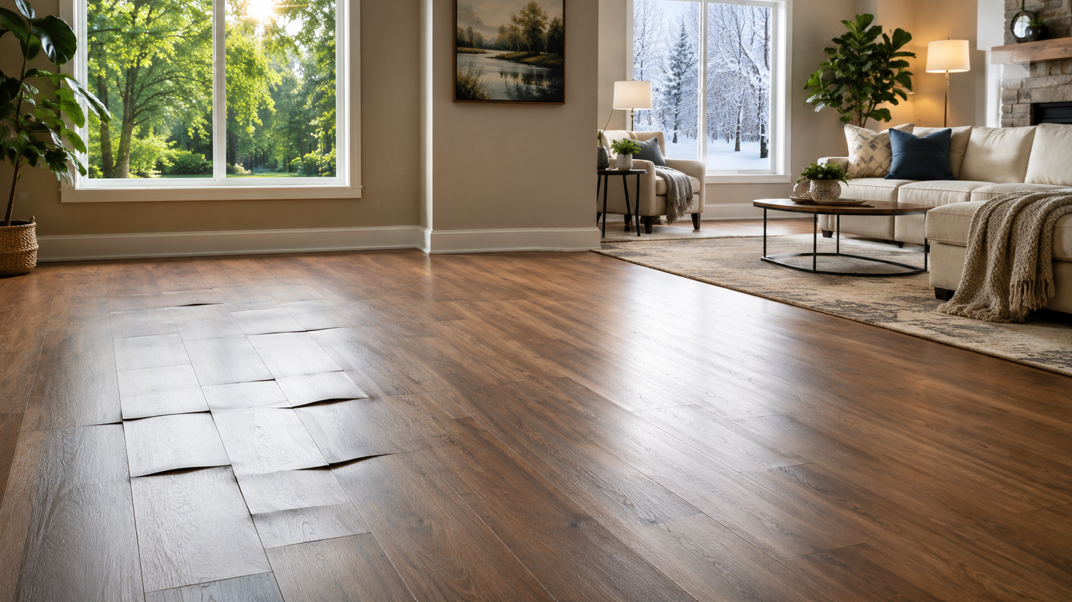
Ohio weather doesn’t stay in one lane for long. A muggy July can make the air inside your home feel heavy, while a heated January can leave rooms noticeably drier. Your laminate floor lives through those changes too, and in some homes, the seasonal swing can show up as lifted planks, tight joints, or uneven areas underfoot.
That doesn’t automatically mean the flooring itself is defective. Laminate can respond to changes in moisture and humidity, but buckling is often connected to a combination of environmental conditions, installation details, water exposure, and the amount of room the floor has to move.
For homeowners around Dayton, Miamisburg, Centerville, Kettering, Beavercreek, Springboro, and the wider Miami Valley, understanding those causes can make seasonal flooring changes much easier to manage. The team at Floorco Flooring helps local homeowners choose flooring with Ohio homes, everyday wear, and long-term performance in mind.
What Laminate Buckling Actually Looks Like
“Buckling” is a broad term homeowners often use for any laminate floor that no longer looks completely flat. In practice, it can appear in several ways.
You may notice:
One or more planks lifting along the edges
A raised ridge where two boards meet
Flooring that feels springy or uneven when you walk across it
Planks pressing tightly against a wall, doorway, or transition
A section that rises after a period of humid weather
Movement near a kitchen, laundry room, exterior door, or another moisture-prone area
A small seasonal gap isn’t necessarily the same as buckling. Many laminate products contain a wood-based core that can respond to changes in the surrounding environment. Problems become more likely when the floor lacks room to move or excess moisture reaches the material.
A floor that begins lifting may be dealing with limited expansion space, moisture exposure, an uneven or damp subfloor, or installation details that restrict movement. The right fix depends on the cause.
What Causes Laminate Flooring to Buckle?
Humidity gets a lot of attention, especially during an Ohio summer, but it’s only part of the picture. Laminate flooring tends to perform best when the product, installation, subfloor, and indoor environment all work together.
Not Enough Expansion Space
Many laminate products are installed as floating floors. That means the connected planks sit over the subfloor rather than being permanently fastened across the entire floor surface.
A floating floor needs room around its perimeter and fixed objects so it can respond to normal dimensional changes. If that space is too limited, expanding planks may eventually press against walls, door frames, transitions, pipes, cabinetry, or other fixed areas.
Once the flooring has nowhere else to move, pressure can build through the connected rows. That pressure may cause a section to peak or lift.
The exact expansion allowance depends on the flooring product and its installation instructions, so there isn’t one measurement that applies to every laminate floor.
Too Much Moisture
Outdoor humidity isn’t the only moisture source that matters.
Laminate can also be affected by:
Plumbing leaks
Dishwasher, washing machine, or refrigerator leaks
Water tracked in from outdoors
Standing spills
Excessively wet cleaning methods
Damp concrete or other subfloor conditions
Basement moisture
Water entering around doors or other vulnerable areas
Airborne humidity and direct water exposure are different issues. A leak can expose flooring to far more concentrated moisture than ordinary seasonal humidity.
Restricted Floating Movement
A floating floor works best when it can move as a connected surface. Problems can arise when parts of the installation pin or restrict the floor.
For example, certain moldings, fixed structures, or installation details may prevent the laminate from moving freely. That doesn’t mean every transition or doorway creates a problem. It means the finished installation needs to follow the requirements for that particular flooring system.
Subfloor Problems
The surface underneath the laminate matters too.
A subfloor that isn’t sufficiently flat can create areas where the floor flexes more than expected. Moisture in the subfloor can also affect flooring performance, particularly in basements or installations over concrete.
Good preparation before installation gives the finished floor a better foundation for long-term stability.
How Ohio’s Humid Summers Affect Laminate
Ohio summers can bring warm temperatures and high humidity, and those conditions can influence the environment inside your home.
When indoor humidity rises, wood-derived components in some laminate flooring products may take on more moisture from the surrounding air. That can cause small dimensional changes. On a properly selected and installed floor, appropriate expansion space helps accommodate normal movement.
Trouble becomes more likely when the floor is already tight against a fixed surface or when other moisture issues are present.
In simple terms, higher indoor humidity can encourage dimensional movement. If the connected floor has enough expansion space, it can accommodate normal changes. If movement is restricted, pressure can show up as lifting, peaking, or tight joints.
Pay Extra Attention to Moisture-Prone Rooms
Certain rooms deserve a closer look during humid weather, especially where airborne humidity can combine with everyday water exposure.
These include:
Kitchens
Laundry rooms
Basements
Mudrooms and entryways
Areas close to exterior doors
Rooms with recurring moisture or ventilation issues
That doesn’t mean laminate is automatically a poor choice for those spaces. Modern laminate products vary considerably in construction, water resistance, and approved applications. The important part is matching the product to the room and following its care and installation requirements.
Keep Indoor Conditions Reasonably Stable
Consistency can help flooring perform more predictably.
During humid weather, homeowners can consider using air conditioning or a dehumidifier when needed, particularly in rooms that tend to feel damp. Addressing basement moisture, leaks, and other sources of excessive indoor humidity can also protect more than just the floor.
If a room experiences large seasonal swings, an indoor humidity monitor can help you see what’s changing. Avoid chasing one universal number because manufacturer recommendations differ.
Watch for Changes Early
A floor rarely needs to go from perfectly flat to severely buckled overnight before it deserves attention.
Look for developing signs such as:
Planks becoming unusually tight at the edges
A new raised area near a doorway or wall
Movement near a transition
A section that changes after prolonged humid weather
A recurring issue that appears around the same season each year
Catching a pattern early can make it easier to identify whether the issue is environmental, moisture-related, or connected to the original installation.
What Ohio’s Dry Winters Can Do to Laminate
Winter creates the opposite environmental challenge.
Once the heating system is running regularly, indoor air can become much drier than it was during summer. Laminate materials may respond by contracting slightly as moisture levels decrease.
That’s why some homeowners notice small seasonal gaps during colder months rather than raised areas.
Seasonal Movement Can Work Both Ways
Think of summer and winter as a yearly cycle.
During humid periods, the flooring may expand slightly. During dry periods, it may contract. The movement itself isn’t necessarily a failure. The goal of proper product selection and installation is to give the flooring system enough tolerance to handle normal changes.
Problems become more noticeable when there’s already limited expansion space, a moisture concern, or another condition that keeps the floor from behaving as intended.
Small Gaps Aren’t Automatically a Major Problem
If you see a slight change at a joint during heating season, don’t assume the entire floor needs to be replaced.
What matters is whether a seasonal change is temporary or worsening, and whether it appears with lifting, swelling, or water damage. A flooring professional can help distinguish ordinary movement from a condition that needs corrective work.
Avoid Extreme Indoor Swings
Keeping the indoor environment reasonably consistent can reduce the severity of seasonal movement.
In winter, that may mean avoiding extreme dryness where practical. Some households use controlled humidification, but it needs to be managed carefully and in line with the flooring manufacturer’s guidance. Adding too much moisture can simply create the opposite problem.
The better target is stability, not a perfect number.
Practical Ways to Help Prevent Laminate Buckling
Preventing buckling starts before the first plank is installed, but homeowners can also do a lot after installation to protect the floor.
Choose a Product That Fits the Room
Not all laminate products are built for the same conditions.
When comparing laminate flooring, consider where it will be installed and how the room is actually used.
Think about:
Whether the room is above grade or in a basement
How often water or spills are likely
Whether pets or children use the space heavily
How the floor will be cleaned
Whether the room has large seasonal humidity swings
The manufacturer’s water-resistance claims and approved applications
Style matters, but performance features can make just as much difference over the life of the floor.
Follow the Product’s Acclimation Requirements
You may have heard that every laminate floor needs to sit in the home for a fixed number of days before installation. That isn’t a safe universal rule.
Some laminate products require acclimation under specified conditions, while others may have different requirements. The correct approach is to follow the installation instructions for the exact product being used.
That helps ensure the flooring enters the installation process under the conditions its manufacturer expects.
Allow the Required Expansion Space
Expansion space is intentional. It gives a floating laminate floor somewhere to move as conditions change.
The required allowance may apply around:
Walls
Door frames
Pipes
Fixed objects
Transitions
Large continuous flooring areas
Because requirements can vary, the installer needs to follow the manufacturer’s instructions rather than relying on a one-size-fits-all gap.
Manage Humidity During Summer
When the weather turns muggy, focus on keeping the indoor environment comfortable and consistent.
Helpful habits include:
Running air conditioning when appropriate
Using a dehumidifier in persistently damp areas
Addressing basement humidity
Repairing sources of excess moisture
Limiting prolonged exposure to humid outdoor air when the home is being cooled
The goal is to avoid large or prolonged moisture swings, not to make the house unusually dry.
Avoid Excessively Dry Winter Conditions
During heating season, pay attention if your home becomes extremely dry.
If controlled humidification is appropriate for your house, follow the flooring manufacturer’s environmental guidance and avoid overcorrecting. A steady indoor environment is generally more helpful than repeatedly moving between very dry and very humid conditions.
Clean Without Saturating the Floor
Laminate is easy to care for when cleaning methods match the product.
Use manufacturer-approved cleaning products and techniques, and avoid leaving standing water on the surface. Wipe up spills promptly, especially around plank joints.
Pay close attention to:
Dishwasher areas
Refrigerator water lines
Washing machines
Sinks
Exterior doors
Pet water bowls
Basement entry points
A small recurring moisture source can matter more than a single humid afternoon.
Deal With Leaks Quickly
If you discover an appliance or plumbing leak, address the source promptly.
Water beneath the flooring can affect the laminate, underlayment, or subfloor. If swelling or lifting follows a leak, professional evaluation can help determine the extent of the problem.
Start With a Sound Subfloor
Before new laminate goes down, the subfloor needs to meet the flooring product’s installation requirements.
That may include checking flatness, moisture conditions, cleanliness, and surface suitability. Concrete, wood, and basement installations can each have different considerations.
What to Do If Your Laminate Is Already Buckling
Seeing a raised section of flooring can be frustrating, but don’t assume replacement is the first step.
The priority is identifying why the floor moved.
Check for an Active Water Source
Start with the obvious possibilities.
Look around the affected area for signs of:
Plumbing leaks
Appliance leaks
Wet baseboards
Water entering from a doorway
Recent spills
Damp basement conditions
Moisture around sinks or laundry appliances
If water is actively entering the area, deal with that source first.
Think About When the Change Appeared
Timing can provide useful clues.
Ask yourself:
Did the floor change after several humid weeks?
Did the problem appear soon after installation?
Is it close to a wall or doorway?
Does it happen in only one room?
Was there a leak nearby?
Does the same section change every summer?
Does the floor look different again during winter?
These details can give a flooring professional better information to work with.
Don’t Force Raised Planks Back Into Place
A lifted section may be under pressure. Forcing it down, cutting the floor, or trying an improvised repair can damage joints or make the original cause harder to identify.
The correct repair depends on the product, the source of pressure or moisture, and how the floor was installed.
Know When an Evaluation Makes Sense
Professional assessment is worth considering when:
The raised area keeps getting worse
Several sections are affected
The floor experienced a significant leak
Planks stay raised after seasonal conditions change
You see obvious swelling or water damage
The cause isn’t clear
The floor was recently installed and the issue appeared quickly
Sometimes the solution involves a limited area. In other situations, moisture or installation conditions may need to be corrected before the flooring itself is addressed.
Getting the cause right first can prevent the same issue from returning.
Keep Your Laminate Ready for Every Ohio Season
Ohio homeowners can’t control what happens outside, but they can create a more stable environment inside.
The best defense against laminate buckling is a combination of smart product selection, installation that follows the manufacturer’s requirements, appropriate expansion space, moisture awareness, and regular care.
Keep these habits in mind:
Choose laminate suited to the room and household
Follow product-specific installation guidance
Leave the required room for natural floor movement
Keep indoor conditions reasonably consistent
Clean without saturating the surface
Address leaks and excess moisture promptly
Pay attention to seasonal changes before they become larger problems
Laminate can be a stylish, durable, and practical choice for busy Ohio homes. With the right product and proper care, it can handle everyday living while delivering the look homeowners want across kitchens, living rooms, bedrooms, offices, and other spaces.
Floorco Flooring brings decades of flooring-industry experience to homeowners throughout the Dayton area, along with a broad showroom selection and professional installation support. If you’re choosing a new floor or you’re concerned about buckling, lifting, or seasonal movement in an existing one, get in touch for personalized guidance.


