

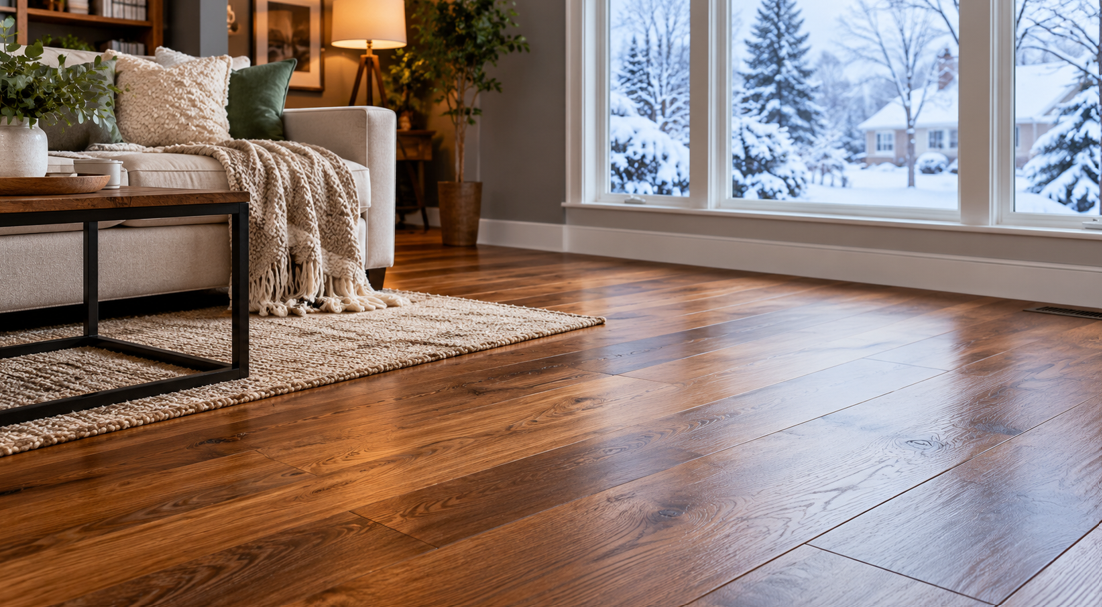
Why Ohio Winters Can Be Tough on Hardwood Floors
Hardwood flooring brings warmth, character, and long-term beauty to a home, but Ohio winters create conditions that can make wood behave differently than it does during warmer months.
When temperatures fall, heating systems run more often. That heated indoor air can become much drier, and natural wood responds to changes in moisture. As hardwood loses moisture, individual boards may shrink slightly. The result can be small gaps between planks, changes around seams, or, in more serious cases, visible cracking.
For homeowners throughout Dayton, Miamisburg, Centerville, Beavercreek, Kettering, and surrounding communities, this seasonal movement can be surprising if the floor looked perfectly tight during summer.
Some movement is part of owning a natural wood product.
The goal is not to stop hardwood from responding to its environment completely. Instead, homeowners can create more stable indoor conditions, choose appropriate flooring, follow proper installation practices, and recognize when seasonal gaps are normal versus when a flooring professional may need to investigate.
At Floorco Flooring, homeowners can compare hardwood options and get guidance on flooring suited to their home, lifestyle, and local conditions.
Understanding why hardwood moves is the first step toward protecting it. Once you know what winter dryness does to wood, preventing excessive gaps and cracks becomes much more manageable.
Why Hardwood Shrinks During Winter
Hardwood is a natural material, which means it reacts to the moisture conditions around it.
Wood contains moisture even after it has been manufactured into flooring. As the surrounding air becomes drier, some of that moisture can leave the wood.
When this happens, the boards may contract slightly.
Dry Indoor Air Changes the Wood
Ohio homes often rely heavily on heating during winter.
Furnaces and other heating systems warm the home, but extended heating can also reduce indoor humidity. As the air dries out, hardwood may gradually lose moisture.
Boards can then become slightly narrower.
Because a hardwood floor is made from many individual planks, even small changes across multiple boards can create visible gaps.
Summer Can Create the Opposite Effect
The same floor may behave differently once warm, humid weather returns.
During more humid periods, hardwood can absorb additional moisture and expand.
This is why gaps that appear during winter may become smaller or disappear during warmer months.
Seasonal expansion and contraction is one reason homeowners benefit from looking at hardwood as a natural, responsive material rather than expecting it to remain completely unchanged throughout the year.
Different Floors May Respond Differently
How noticeable seasonal movement becomes can depend on factors such as:
Hardwood species
Board width
Solid versus engineered construction
Installation method
Indoor humidity
Heating patterns
Subfloor conditions
The amount of seasonal change inside the home
Two homes on the same street can therefore experience different levels of seasonal flooring movement.
Are Winter Gaps in Hardwood Normal?
Small gaps between hardwood planks during dry winter months are not automatically a sign that something has gone wrong.
In many cases, mild seasonal movement is expected.
Small Seasonal Gaps
If narrow gaps appear during winter and begin closing again when humidity returns, the floor may simply be responding naturally to seasonal conditions.
These gaps may be more noticeable in certain parts of the room, particularly where boards receive more heat or where indoor conditions fluctuate.
When Gaps Deserve More Attention
Some situations are less likely to be explained by routine seasonal movement alone.
Consider getting professional guidance if you notice:
Very large or irregular gaps
Gaps that continue growing
Boards separating from one another
Cracks running through individual planks
Loose or moving boards
Significant changes that remain throughout the year
Flooring lifting or becoming uneven
Multiple types of damage appearing together
These symptoms can have different causes, so it is better to identify the actual issue rather than assuming winter dryness is responsible for everything.
Cracks and Gaps Are Not Exactly the Same
A gap usually appears between two boards.
A crack occurs within the wood itself.
Both can be influenced by changing moisture conditions, but cracking may also relate to the individual board, installation conditions, extreme dryness, impact, or other factors.
That distinction is useful when describing the problem to a flooring professional.
Keep Indoor Humidity More Consistent
One of the most helpful things homeowners can do for hardwood during winter is reduce extreme changes in indoor moisture.
Hardwood generally performs better in a reasonably stable environment than in one that becomes extremely dry for months and then dramatically more humid later.
Monitor Indoor Humidity
A simple indoor humidity monitor can help you understand what is actually happening inside the home.
Without one, it is easy to assume that a room feels comfortable while the air is still much drier than usual.
Pay particular attention during extended cold periods when the heating system is running frequently.
If the manufacturer of your hardwood specifies an acceptable indoor humidity range, use those recommendations as the primary guide for that product.
Consider Whole-Home Humidity Control
Some homes use whole-home humidification systems connected to their heating setup.
These systems can help regulate moisture more consistently across multiple rooms rather than treating only one small space.
Whether this approach makes sense depends on the home, heating system, and existing indoor conditions.
Portable Humidifiers Can Help Specific Rooms
In some situations, homeowners may use a portable humidifier in a room where hardwood is particularly affected by dry air.
The goal is controlled humidity, not excessive moisture.
Adding too much moisture creates a different set of flooring concerns, so avoid trying to compensate for winter dryness by making the room overly humid.
Keep Conditions Stable Where Possible
Sudden changes can be harder on wood than gradual, moderate seasonal changes.
A reasonably consistent indoor environment can help reduce the amount of expansion and contraction the floor experiences.
Watch for Heat Sources That Can Dry Certain Areas Faster
Not every part of a room experiences exactly the same conditions.
Some areas may be exposed to considerably more heat than others.
Heating Vents
Hardwood located directly beside or above strong heating airflow may dry faster than flooring elsewhere in the room.
If you notice that gaps appear most prominently near vents, the local heating pattern may be contributing.
Avoid permanently blocking necessary airflow, but consider whether furniture placement or vent direction can be adjusted appropriately without interfering with the heating system.
Fireplaces and Space Heaters
Fireplaces and portable heaters can create concentrated heat.
Flooring close to these sources may experience different conditions from the rest of the room.
Using supplementary heat responsibly and maintaining stable room conditions can help reduce extreme local drying.
Direct Sunlight
Winter sunlight may seem harmless, but strong direct exposure through large windows can warm particular sections of flooring.
Sunlight can also affect floor color over time, depending on the wood and finish.
Window treatments can help manage intense exposure where necessary.
Choose Hardwood With Seasonal Movement in Mind
Preventing winter problems can begin before the flooring is installed.
Different hardwood products respond differently to changing conditions, so product selection matters.
Solid Hardwood
Solid hardwood is made from a single piece of wood.
It offers the traditional construction many homeowners want and can provide lasting beauty when installed in appropriate conditions.
Because it is natural wood throughout, it responds to changes in moisture.
Board dimensions, species, installation conditions, and the indoor environment all influence how much movement becomes visible.
Engineered Hardwood
Engineered hardwood uses a real hardwood surface over a layered core.
Its construction can provide greater dimensional stability in certain conditions compared with some solid hardwood products.
That does not make engineered hardwood immune to environmental changes.
It can still respond to moisture and requires proper installation and indoor conditions. However, engineered construction may be worth considering when seasonal stability is a major concern.
When comparing hardwood flooring, look at construction, species, plank width, installation requirements, warranty information, and manufacturer recommendations together rather than choosing based only on appearance.
Think Carefully About Plank Width
Wide-plank hardwood can create a beautiful, upscale appearance, but plank width can also influence how seasonal movement looks.
Wider Boards Can Make Movement More Noticeable
Because each individual board covers more width, dimensional changes across a wide plank may be more visible than similar movement across narrower boards.
This does not mean wide-plank hardwood is a poor choice for Ohio homes.
It simply means homeowners interested in wider boards benefit from paying close attention to product construction, installation recommendations, and environmental control.
Narrower Boards Create More Seams
Narrow hardwood has more joints across the same room.
Each individual board may show less dimensional change, although the floor still responds to changing conditions overall.
Choose Based on the Entire Flooring System
Plank width is only one variable.
Species, construction, finish, subfloor, installation method, and the home's indoor environment all work together.
A knowledgeable flooring professional can help compare these factors before installation.
Proper Acclimation Before Installation Matters
Hardwood should not arrive at a home and automatically be installed without considering the manufacturer's requirements and site conditions.
Many products need time and appropriate conditions before installation.
What Acclimation Means
Acclimation allows flooring materials to adjust to the environment where they will be installed when the manufacturer requires that process.
The goal is for the flooring and the building conditions to be appropriate for one another before installation begins.
The Home Needs to Be Ready Too
Acclimation is not simply leaving unopened flooring boxes inside the house for an arbitrary number of days.
The building should be under the normal environmental conditions expected after installation.
Heating, cooling, moisture conditions, and the subfloor can all matter.
The correct process depends on the flooring product and manufacturer instructions.
Avoid One-Size-Fits-All Timelines
You may see generic recommendations online suggesting that all hardwood needs to sit inside the home for a specific number of days.
That is not reliable guidance for every product.
Different manufacturers, wood products, and installation systems can have different requirements.
Following product-specific instructions is more useful than applying one universal acclimation rule.
Subfloor Conditions Can Affect Hardwood Performance
The hardwood itself is only one part of the flooring system.
What sits underneath it matters too.
Moisture Conditions Need Attention
An installer may need to assess whether the subfloor and hardwood are suitable for installation based on the product requirements.
Installing flooring when moisture conditions are not appropriate can contribute to problems later.
The Subfloor Needs to Support the Installation
A properly prepared subfloor helps create a stable foundation.
Depending on the flooring and installation method, preparation may involve checking:
Flatness
Condition
Cleanliness
Structural stability
Moisture
Compatibility with the flooring system
Trying to solve visible hardwood problems later is much less appealing than making sure the foundation is suitable before installation.
Avoid Overreacting to Small Winter Gaps
A homeowner may notice the first small line between two boards and immediately assume the floor is failing.
That can lead to unnecessary repairs.
Give Seasonal Movement Time
If the gaps are small and appear only during the driest part of winter, monitor them as conditions change.
They may begin closing as indoor humidity rises.
Be Careful With Permanent Fillers
Trying to permanently fill every seasonal gap can create problems if the boards later expand.
A material placed into a gap while the floor is contracted may interfere with normal movement once humidity returns.
Before attempting a permanent repair, determine whether the gap is truly permanent.
Take Photos Throughout the Seasons
If you are unsure whether a gap is changing, photographs can help.
Take pictures during winter and compare the same area during spring or summer.
This provides useful information about whether the change is seasonal or persistent.
It can also help a flooring professional better understand what the floor is doing over time.
Simple Winter Habits That Can Protect Hardwood
You do not need a complicated maintenance routine to take good care of hardwood during an Ohio winter.
A handful of consistent habits can make a meaningful difference.
Track Indoor Conditions
Monitor the room rather than relying only on how the air feels.
Seasonal dryness can become significant before homeowners notice it.
Clean Up Snow and Moisture Near Entrances
Winter can create an unusual combination: very dry indoor air but wet shoes near exterior doors.
Snow, slush, and moisture tracked inside can expose entrance-area flooring to liquid even while the rest of the home is dry.
Use appropriate mats and clean up moisture promptly.
Keep Grit Off the Floor
Salt, sand, and outdoor debris can be tracked indoors during winter.
These particles may scratch the finish when walked across repeatedly.
Regular sweeping or vacuuming with a hardwood-appropriate setting helps reduce abrasive debris.
Use Furniture Protection
Furniture pads help protect the floor when chairs, tables, and other items move.
Check the pads occasionally for trapped grit.
Follow Manufacturer Cleaning Instructions
Avoid assuming that every hardwood finish can be cleaned with the same products.
Use the cleaning methods recommended for your particular floor.
What Not to Do When You See Winter Gaps
Understanding what to avoid can be just as valuable as knowing what to do.
Do Not Flood the Room With Humidity
If you notice gaps, the answer is not to raise humidity as quickly and dramatically as possible.
Too much moisture can cause expansion and other flooring problems.
Aim for stable conditions consistent with the flooring manufacturer's recommendations.
Do Not Assume Every Gap Needs Repair
Some seasonal gaps are temporary.
Wait to understand whether the boards return toward their normal position when conditions change.
Do Not Use Random Fillers Without Guidance
Products designed for one type of flooring issue may not be appropriate for another.
A seasonal gap, permanent installation gap, damaged board, and cracked plank are different problems.
Do Not Ignore Major Changes
While small seasonal movement may be normal, dramatic or persistent changes deserve attention.
If boards are separating significantly, lifting, cracking extensively, or moving underfoot, professional evaluation can help identify the cause.
When to Call a Flooring Professional
Most homeowners do not need professional assistance every time they notice a hairline winter gap.
However, some situations deserve a closer look.
Consider professional advice if:
Gaps remain after seasonal conditions change
The openings are unusually wide
Numerous boards are cracking
Boards move when walked on
The flooring is lifting or becoming uneven
Damage appeared suddenly
The problem is concentrated in one unusual area
You are unsure whether humidity, installation, or the subfloor is involved
A flooring professional can look at the entire system rather than treating the visible gap as the only issue.
That may include considering the wood itself, indoor conditions, subfloor, installation method, heating, and the location of the damage.
Protect Hardwood by Planning for Ohio's Seasons
Hardwood and Ohio winters can work very well together.
The important thing is recognizing that natural wood responds to its environment.
When indoor air becomes dry during winter, hardwood may lose moisture and contract. Small seasonal gaps can therefore appear even in an otherwise healthy floor.
Maintaining more consistent indoor conditions can help reduce extreme movement. It is also worth paying attention to concentrated heat sources, choosing an appropriate hardwood product, following manufacturer acclimation requirements, and making sure installation conditions are suitable from the beginning.
Once the floor is installed, simple habits can continue protecting it.
Keep winter grit and moisture under control, follow the manufacturer's cleaning guidance, use furniture protection, and monitor unusual changes instead of trying to permanently repair every small seasonal gap.
Most importantly, look at the pattern over time.
A small gap that appears during a dry January and closes again as humidity returns is very different from a widening gap that remains throughout the year.
Floorco Flooring brings decades of flooring industry experience to homeowners throughout the Dayton area and can help you understand product options, installation considerations, and seasonal performance.
If you are planning new hardwood flooring or have questions about gaps, cracks, or seasonal changes in an existing floor, get in touch with the Floorco Flooring team.


